


0
Science Experiments
Experiments often conducted by students to test different scientific theories and hypotheses
11,111 Questions
Why are multiple trials important when carrying out an experiment?

So the experiment's results are more reliable
How do models help the understanding of abstract concepts?
models help the understanding of abstract concepts.
How would magnets make a plant grow taller and faster?
Magnets exert magnetic fields, as do electrical currents through wire. These magnetic fields have no impact on water transport through plant tissues, or on any of the minerals plants take up from the soil. Nor would magnets improve the process of photosynthesis. Theoretically, magnets should not have any impact on plant growth. Of course, this would need to be tested, preferably in a double blind experiment to rule out any effect of bias contamination of the results.
Three groups of plants--one with magnets, one with non magnetic masses of roughly the same mass and density in place of the magnets, and a third control group with neither magnets or fake magnets should be grown in homogeneous soil, subject to equal measures of sunlight and water. The expected result would be no statistically significant difference in germination rate, plant growth, flower and fruit production, or overall plant longevity.
How can you find the perfect science fair project?
To find the perfect science fair project, you have to find what you are interested in. Then add your own idea and BOOM, you have a project.
Double blind conditions
How does a catapult perform energy transformation?
Catapult can work in different ways. The most common catapult we think of to day is the steam catapult used on aircraft carriers. The steam isallowed to build up pressure and released when the pressure is high enough to move the weight of the plane. This pressure release pushes on a piston much like a cars. that piston is pushed down a shaft till the end of that shaft. the counter reaction is the plane moving in the other direction. Newtons law works once again.
MKS
How long does a conclusion have to be for a science fair project?
Usually a paragraph, but most of the time length doesn't matter it is all about the content. Sometimes multiple paragraphs, depends on your grade.
Balance refers to the equal distribution of weight or force in different parts of a system to maintain stability. In nature, balance is achieved through various mechanisms such as feedback loops, counteracting forces, or homeostasis. It is essential for maintaining harmonious relationships and preventing chaos or instability.
What should be written if there are no constants to a science project?
you should write the same thing as a regular science fair project which is the first paragraph is explaining your project and the body paragraphs are going more deep into your science fair thought/project. It would be the same process but all you have to do is try to add some of your details since your project has no constants.
At what temperature does water have its lowest volume?
About 4 degrees Centigrade.
About 4 degrees Centigrade.
About 4 degrees Centigrade.
About 4 degrees Centigrade.
Suggest 2 ways to minimize the friction on the boat?
One way is to ensure that the hull is as smooth as possible to minimise drag through water- use an antifoul coating to minimise organism growth in the surface which could cause drag. Another method is to include an arrangement of ridges in the hull, these can be designed to lift the boat out of the water more at speed, reducing the contact and drag with the water.
What is a catchy title for a science project on reflexes?
- Kick Me!
- Don't Kick Me!
- Just Kick It
- A Kick in the Pants
- Why does your doctor whack you in the knee?
- Acting without thinking
- The spinal cord as an extension of the brain
- There is more to reflexes than than tapping the knee
- The knee isn't the only one
- BABINSKI
- What reflexes tell us about the condition of the spine/spinal cord
- What reflexes tell us about the condition of the brain
- What reflexes tell us about DRUGS
- How Edema and other head injuries affect reflexes
- Reflexes of the Eye
- Can a cat walk with a severed spine?
- Asymmetric reflexes and what they tell us
- Your eyes as a reflection of your brain on drugs
How do you measure the temperature of fire?
You can be simple and use a meat thermometer they you use to measure the heat of cooked meat
What are the variables in a scientific experiment?
There are 3 different variable. The independent variable is what you will be changing in the experiment and there should only be one. The dependent variable is what you will be measuring or observing. The controlled variable is what you will be keeping the same and there can be more than one. There is no limit on how many controlled variables you can have.
An energy source that heats fuel rods is?
Nuclear energy is produced when fuel rods containing radioactive material such as uranium-235 are heated within a nuclear reactor. The heat generated from the fission of the uranium atoms is used to produce steam, which drives turbines to generate electricity.
How does inertia affect an object?
Inertia guarantees that an object at rest will remain at rest and an object in motion will remain in that same motion, so long as there is no external force acting on that object. Alternately, there could be force acting on it as long as that force adds up to zero.
What is the example of conduction?
An example of conduction is when a metal spoon placed into a hot cup of coffee becomes warm to the touch. This is because the heat from the coffee is transferred to the spoon through direct contact, causing the molecules in the spoon to vibrate and generate heat.
What are some science experiments for kids?
Some experiments that I have done with my children are
erupting volcano
you will need:
baking powder
fake volcano made out of play dough
vinegar
another experiment is the pepper trick
you will need:
pepper
container
water
detergent
first you put the water in the container then put the pepper in, dip your finger in detergent and put your finger into the water with the pepper, then watch what happens.
another experiment is the floating egg
1) get an egg
2)get a glass of water
3)fill the glass with cold water
4)put salt in the water
5) mix the salt water with a spoon or fork
6)put egg in salt water and watch what happens
What is a good lightning science fair project?
I would NOT recommend a kite in a thunder storm.
However, you could do a poster-project.
Look up lightening strikes on humans per year.
Mortality rate from lightening strikes.
Perhaps follow stories of individuals. News releases.
Number of lightening strikes across the USA
Design issues with lightening rods, lightning arrestors.
Take apart a surge suppressor. What is inside? Identify the parts.
Do they work?
What about a UPS? Is it better?
The Jacobs Ladder is a "cool" device. Perhaps not exactly lightening, but it would certainly be entertaining to build one.
Look up on the web, or see: http://www.amazing1.com/jacobs-ladder.htm
It is a common device and you will find lots of FREE information on the WWW.
Certainly when dealing with electricity, it requires lots of care, and adult supervision is recommended.
Why can a pencil sharpened at both ends be used as a conductor in laboratories?
Despite the name "Pencil Lead", pencils actually have no real lead in them. They are a graphite/clay that has a slightly shiny slate gray look that resembles lead.
Take your pencil, sharpened on both ends, or at least having access to the lead and the wood on both ends (and not being cracked in the middle).
Set your multimeter to Ohms (it doesn't really matter what level, somewhere in the middle). It should read 0 when the probes are separate, and 0 when they touch.
Now, touch the wood on both ends, and does it conduct?
Touch the lead on on one end and wood on the other end. Does it conduct?
Touch the lead on both ends. Does it conduct?
Wood is mainly long chain carbon-hydrogen chains and carbohydrate chains, etc. Mainly desaturated (single bonds). And, it turns out to be a relatively non conductive.
Graphite, on the other hand, has what is called delocalized bonds from the basic unit which is like benzine with essentially 1 1/2 bonds all the way around it.
See Wikipedia Articles:
http://en.wikipedia.org/wiki/Benzene
http://en.wikipedia.org/wiki/Delocalized_electron
http://en.wikipedia.org/wiki/Graphite
The basic unit of graphite is the benzine ring with delocalized electrons.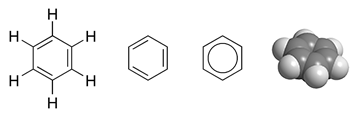
Graphite is a mesh of benzine rings, without the hydrogen atoms, but delocalized electrons and essentially 1 1/2 bonds throughout.

These delocalized electrons actually make graphite act very much like a metal and makes it an excellent electrical conductor.
See Wikipedia Article on Metallic Bonds:
http://en.wikipedia.org/wiki/Metallic_bond
Images are from Wikipedia from pages referenced above, and are part of the Public Domain. Line drawing of delocalized graphite was created by the first editor of this article, and is hereby released into the public domain.
An experiment in which all variables stay the same is called?
An experiment in which all variables stay the same is called a "controlled experiment".
