0
Greece
Greece is a country made up of many islands. It has a rich history filled with gods, goddesses, wars, tragedies, romances, and some of the best myths of all time. Questions in this section can include things about current or ancient Greece.
4,004 Questions

It is still unknown how the civilization of Crete disappeared, but we know that the Mycenaes conquered Crete, so they fought against the people from Crete, who weren't ready to fight because of a volcanic eruption that happened before.
How long does it take to fly from New York to Greece Santorini?
Pittsburgh-Paris-Athens-Santorini: approx. 18 hours with Air France and Aegean Airlines.
Why are more than 100 aegean islands between mainland Greece and crete know as the cyclades?
The Cyclades islands, which lie in the Aegean sea south and west of the Greek mainland, are so named because of their circular position around the ancient sacred island of Delos.
For a more complete explanation, I've referred to the Encyclopedia of World Cultures, via Gale Virtual Reference Library. According to this publication, the Cyclades islands are:
"They are the peaks of a range of submerged mountains, separated by deep channels from the islands to the south and east."
Additionally, the islands have a rich history as part of the ancient Greek civilization:
"Although subject to the cultural influences of other areas (particularly Mycenean and Minoan influences) and to periodic invasions and/or waves of immigration, the islands developed a distinctive Bronze Age culture with a now well-recognized Cycladic art, perhaps most clearly represented in the characteristic Cycladic marble figurines. In the eleventh century B.C., at the end of the Bronze Age, the Cyclades underwent a decline in population, but by the ninth to eighth centuries B.C. their population began to grow again, and new settlements were established. In the classical period some Islands were the home of independent city-states. From the eighth century B.C. the island of Delos was an important holy place for Ionian Greeks; during Hellenistic times it was an International merchant community as well, and it continued to flourish into Roman times. Ravaged by Mithridates of Pontus in AD. 88, it fell into decline, and then eventually into oblivion with the arrival of Christianity. After the Romans, the Cyclades became part of the Byzantine Empire."
I hope this helps! You can access databases like Gale Virtual Reference Library, where I found this answer, through your local library. Many library web sites even have a link where you can chat online with a librarian 24 hours a day, 7 days a week!
Kathryn Benson
Future Librarian and Slam the Boards! participant
University of Texas at Austin
MSIS expected Spring 2013
Source:
Dubisch, Jill. "Cyclades." Encyclopedia of World Cultures. Vol. 4: Europe. New York: Macmillan Reference USA, 1996. 75-79. Gale Virtual Reference Library. Web. 11 Nov. 2012.
What flowers are native to Greece?
From personal experience roaming the islands, I am "guessing" that it is the geranium, particularly red ones. They abound everywhere all summer and fall!
What body of water lies between Italy and Greece?
The narrow body of water between Sicily and Italy is called the Strait of Messina.
What effect did greece's geography have on th occupation the people engaged in?
they were slaves that would work outside on jobs like mining planting houling stuff around and taking care of animals that the Greeks might have owned. there were also inside slaves that were treated like family, cooked, weaved, and took care of kids.
When was Greece at its largest?
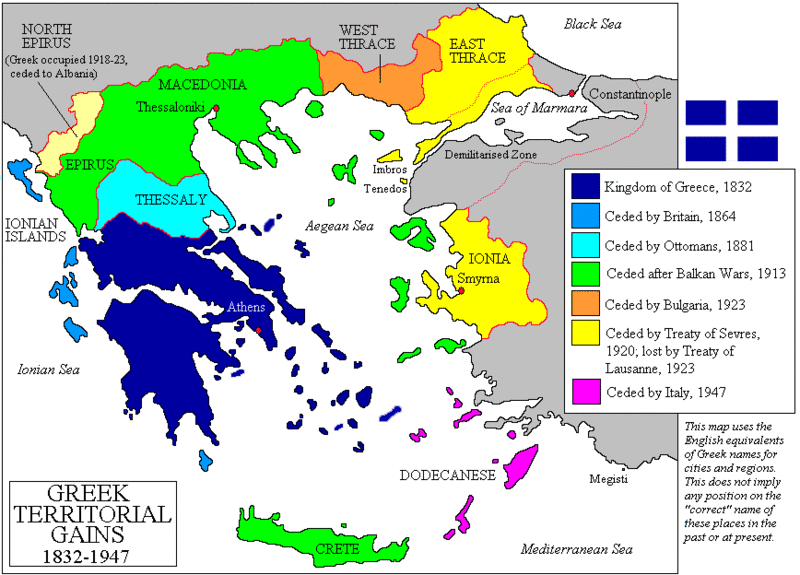
The modern Greek State was at its largest between 1919-1923 when the Treaty of Sevres was in force but before the Turkish Independence War resulted in the Treaty of Lausanne. At this point Greece even controlled territory on the Anatolian mainland (but did not control Rhodes).
You can see a map of Greek expansions and losses in this map.
What does Greece's money look like?
Italy, like many other European countries, utilizes the Euro as its form of currency. The colorful Euro bills depict scenes from ancient Roman culture, while the coins feature prominent Italian historical figures.
Why did Xerxes conquer Greece?
He did not conquer Greece. He attempted to bring the independent Greek city-states under control to bring peace and stop them disrupting his empire, but failed. The Greeks went back to fighting each other.
Macedonia (in Greek: Μακεδονία Makedonίa) is a the second most populous and the biggest in size region of Greece. It is located in north Greece. Gradually it's in Europe, Southeastern Europe, Balkans, South Balkans, north Greece. It borders with Thrace and Epirus and three countries: Albania, FYROM and Bulgaria. Its south coasts are washed by the Aegean sea.
What do you call a native of Greece?
The Greeks call themselves Hellenes. This derived from their traditional founder Helen. The country they call Hellas.
Others call it Greece and the people are called Greeks. This originated in a misconception - when the Romans were penetrating the south of the Italian peninsula over 2300 years ago they came across a tribe called the Gaeci. Going further south they found the Greek cities on the southern coast (Tarentum, Sybaris etc) and imagining this area was also inhabited by Graeci, they called it Magna Graeci (Great Grece).
The name stuck, and today we still call these people Greeks. The Greeks call themselves Hellenes, but have to go with the flow of what the rest of the world calls them.
What geographical advantage does the Italian landscape have over the Greek landscape?
Italy is northwest, mostly west, of Greece.
What vegetables are grown in Greece?
The area covered by horticultural crops is 31% of the total area covered by plant crops, but the gross value of the horticultural crops is 55% of the plant crop production and 39% of the total agricultural production. The main horticultural crops are: Olive trees (for olive-oil and table olives), vineyards (for table grapes, wine and raisins: sultana or black Corinth), citrus, almond, peach, apricot, apple, pear and fig trees, vegetables, flowers (cut and pot plants) and ornamental plants. Area of horticultural crops (in thousand ha): Total 1.227,4 (irrigated 371,2), fruits 962,2, grapes 135,6, vegetables 128,8 (in GH 4,9), flowers and ornamental plants 0,6 (in GH 0,2). Total value of horticultural products (in thousand EUR) 1.193,455
The olive tree orchards are localized mainly along the coastal zone and up to a maximum elevation of 600 m, the vineyards are localized in areas with a maximum elevation of up to 1.000 m and both are usually not irrigated crops. Other important horticultural crops producing irrigated areas are: For citrus Peloponnesus (Lakonia, Argolis and the Northern Peloponnesian zone). Crete (Heraclion, Chanea) and Arta, for peaches western and central Macedonia. For apples and pears Magnesia and western Macedonia. For apricots Argolis and the Northern Peloponnesian zone. For vegetables different plains or valleys and for flowers Attica, Troezinia, Crete etc.
Joseph John Campbell said that these structures are what is most important to the society at the time of construction.
In Salt Lake City Utah after the occupation of the Ute and Shoshone lands by the Mormon "pioneers" the Temple was the biggest most prominent building.
When the Mormon's were concern for their survival, government becomes of utmost concern, during this time the Capitol building is the the biggest building on a bluff overlooking the city.
Today the Church office building that runs the business of the Church (LDS) is the biggest most prominent building and the church complex is huge.
Here we use the Mormons as an example of what is a long historical truth, we do not invest huge quantities of labor and money in what is not important.
I believe the Parthenon was a replacement of a temple to Athena, which like war memorials today told of their power and leadership in the Delian League.
What did the greek goddess cassandra look like?
The depictions of the Greek goddess Cassandra vary greatly from the number of retellings and artist depictions. However, many artists depict her with reddish-copper hair and a fair to medium complexion. The only thing that is consistent is her being described as beautiful.
What toys were popular in Greece?
spinners were very popular those days spinners were very popular those days
No Greece is not part of Italy. Greece and Italy are two seperate countries in Europe. They are also very close to one another on the globe.
What caused Darius to conquer Greece?
The Persuian War was 499-449 BCE. The idea of First, Second, Third Persian Wars is a modern misconconstrution.
Also, Darius did not attack Greece, as there was no country of Greece. There were hundreds of independent city-states, some within the Persian Empire, some outside.
The starting problem was the Ionian Revolt where the Greek cities in Persian Asia Minor revolted and were put down.
During this revolt, Eretia and Athens, both outside the Persian Empire, gave aid to the revolting cities. Darius sent a punitive expedition in reprisal. It was defeated at Marathon.
He then planned to bring all the Greek cities under his control to put an end to Greek breaches of peace, order and prosperty. He died before mountig this attempt, but it was carried out by his son and successor Xerxes I.
What was one cause of the development of many small dependent city-states in ancient Greece?
City-states developed in Greece for a multitude of reasons. This list is not exhaustive, but mentions a few key reasons that city-states developed in Greece:
1) Minimal Land Travel: The Greek Mainland (Thrace, Epirus, Boetia, Attica, and the Peloponnesus) is among the most mountainous and hilly land in all of Europe, making land travel between the city-state minimal. It also directed their efforts away from expanding their influence primarily over land and explains why non-coastal regions of Greece took the longest to develop.
2) Marine Travel and Naval Strength: Most of the city-states were relatively close to the water, especially those found on Crete, Cyprus, the Dodecanese Islands, or Cycladic Islands. Greek city-states favored marine travel which was more reliable and cost-effective than land travel. As a result, many city-states had strong navies as opposed to having strong armies. (Sparta is the one major exception to that rule.)
3) Chronic Disunity: Because of the prevalence of strong navies, the difficulty of land travel, and the presence of many invasion choke-points (the most famous being Thermopylae), the Greek city-states were never completely unified until Alexander the Great conquered them all. (Sparta did defeat Athens in the Peloponnesian War, but only held onto that victory for a very short time. In addition, Sparta never expanded its power into Boetia or over the Cycladic Islands - which would have been the next logical places to expand.)
4) Pastoralism and Fishing: The mountainous terrain made growing crops very difficult. The two crops that the Greeks were able to cultivate were olives and wheat, but wheat was much more difficult to maintain than the olives. This forced Greeks to resort to pastoralism (primarily animal-based agriculture) and they raised goats, sheep, and pigs. As a result, there was a lot of dairy and meat in the Greek diet relative to contemporaneous civilizations (although significantly less than today). In addition, because of the access to the sea, Greek cuisine included vast amounts of shellfish, mollusks, and proper fishes.
5) Iron Age: The common Greek people of the four branches of Greece, Doric, Aeolic, Ionian, and Attic, were no longer dependent on the kings of the Mycenaean Era who had consolidated power with their wealth and ability to possess bronze weapons. With the advent and easier accessibility of iron Greeks were able to forge weapons for themselves and were able to form states along natural geographical lines within Greece. This happened gradually and so different states had evolved differently which saw Homeric style kingdoms like Macedonia and Epirus exist with diarchies like Sparta and democracies like Athens and for a brief time Argos.
What happend that led the Greek city-states to unite?
A group of cities would form defensive leagues when under threat.
What did Socrates do in history that he is so famous?
He is credited as one of the founders of Western Philosophy, but don't take my word for it, read for yourself. It's what Socrates would have wanted.
http://en.wikipedia.org/wiki/Socrates